Welcome to our invertebrates glossary! Here you will find words that you should familiarize yourself with before watching the pre-recorded lesson. During our live session, you will have the opportunity to ask any questions you may have, so don't forget to jot them down!
Acoelomate
Adjective
Animals without a fluid filled cavity surrounding their organs. Platyhelminthes are acoelomates and can be split in half and will live on completely normally.
Example: Flatworms are acoelomates.
Bilateral symmetry
Noun
An organism that's symmetry splits it in half.
Example: All arthropods exhibit bilateral symmetry.
Chitin
Noun
The main component of arthropod exoskeletons, made of polysaccharides.
Example: Arthropod exoskeletons are made of chitin.
Coelomate
Adjective
Animals with a fluid-filled cavity that lets their organs move, providing some shock resistance (similar idea to the fluid cushion in the skull for the brain).
Example: Earthworms are coelomates.
Detritus feeders
Adjective
Organisms that eat “matter composed of leaves and other plant parts, animal remains, waste products, and other organic debris that falls onto the soil or into bodies of water from surrounding terrestrial communities.”
Example: Annelids are detritus feeders.
Deuterostome
Noun
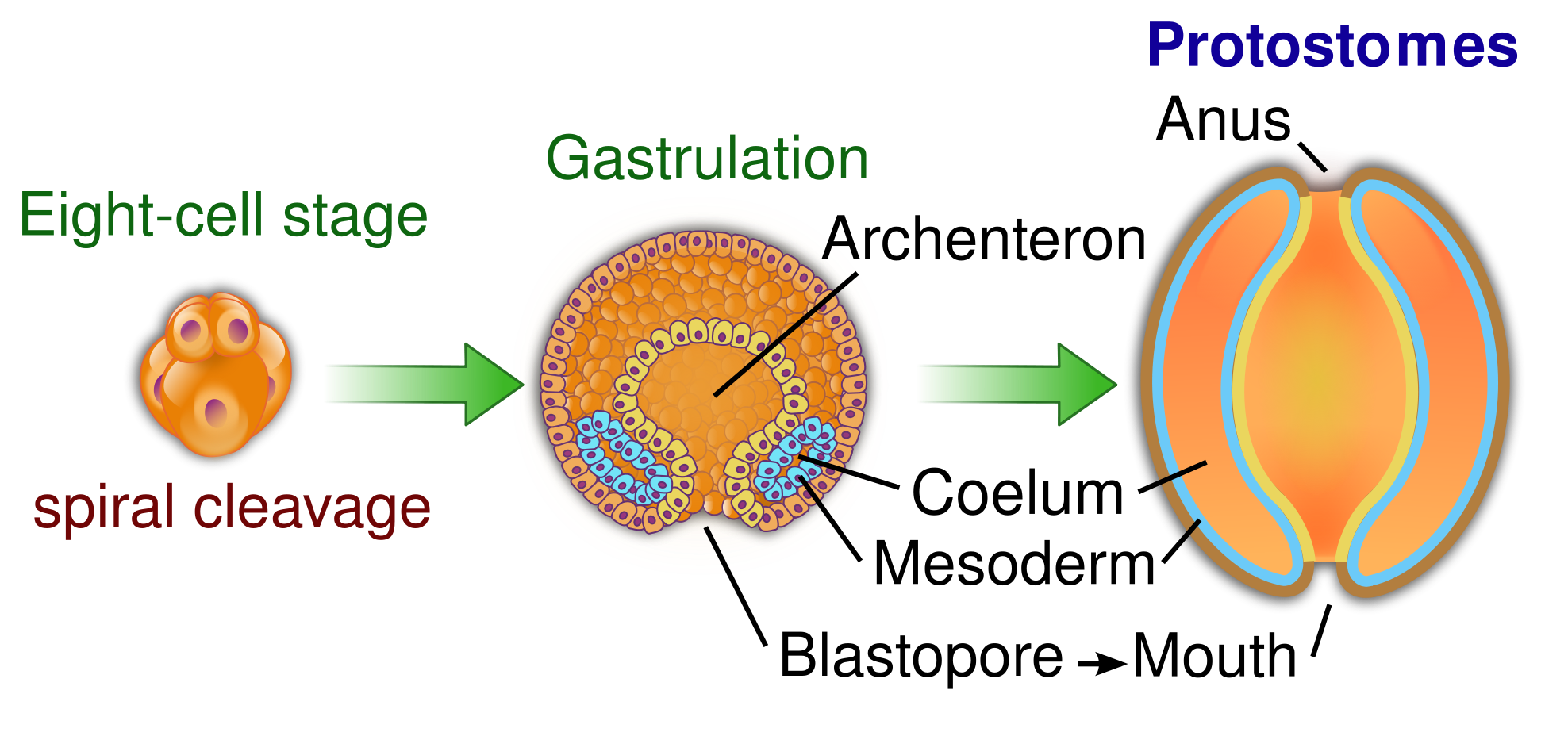
An organism that, along with other particular characteristics, has blastopores that develop into an anus.
Example: A starfish is a deutrostome.
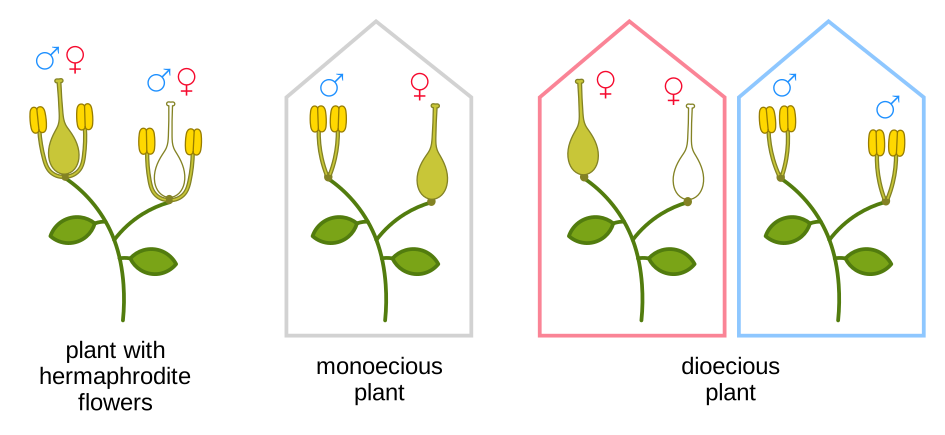
Dioecious
Adjective
This characteristic means that male and female sex organs can be found in separate individuals. It is used to describe invertebrate animals as well as plants.
Example: Humans are dioecious.
Diploblastic
Adjective
Animals with two primary germ layers (eg. jellyfish, corals, and sea anemones)
Example: Echinoderms are diploblastic.
Exoskeleton
Noun
The external skeleton of an animal’s body. It helps keep its organs safe.
Example: All arthropods have an exoskeleton.
Filter feeder
Noun
“A form of food procurement in which food particles or small organisms are randomly strained from water.”
Example: Some sponges are filter feeders.
Metamorphosis
Noun
The process of animal development after hatching or birth, causing physical structure changes.
Example: Butterflies undergo metamorphosis.
Protostome
Noun
An organism that, along with other particular characteristics, has a blastopore that develops into a mouth.
Example: Humans are protostomes.
Radial body symmetry
Noun
The symmetry of the body on a central axis, these organisms have a top and bottom but no right or left sides.
Example: Cnidarians display radial body symmetry.
Segmentation
Noun
The division of an organism’s body into similar repetitive sections.
Example: Worms display segmentation
Triploblastic
Adjective
Animals with three primary germ layers (eg. all vertebrates, molluscs, echinoderms and arthropods)
Example: Mollusks are triploblastic.
Zooid
Noun
"A single animal that is part of a colonial animal."